ACSM Exam... Tougher Than a Two Dollar Steak!
by Jalen Krupa
(Reno, NV)
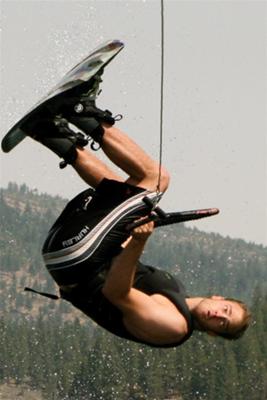
Me throwing down a back roll on the wakeboard
ACSM Exam... Tougher Than a Two Dollar Steak! I just finished taking the ACSM exam, (for the second time) and I have to say… This is no walk in the park. For the people that said it was easy… Please spare me with the “I’m so smart” and “I can pass this test with my eyes closed” comments. C’mon now, how about sharing your test scores with us? Oh what’s that, you passed but barely passed? Hmm, that’s surprising. Well, not really.
Oh, you did get a high score… Now I’m surprised! What’s that you say? You’ve been a personal trainer now for 6 years and you went to college to get a degree in the health and fitness field? Okay, I get it now. ACSM is not a certification for newbie’s like myself, (Hence the reason why this exam was so hard for me). I guess it’s all starting to make sense now…
Or is it? Now, I understand that to receive a certification in personal training, you have to be knowledgeable about the field. As ACSM puts it, “…a summative amount of knowledge at a level of at least minimal competency…” Alright, I understand this, but what I don’t understand is why I’m solving questions like, “Albuterol, terbutaline, glucocorticosteroids, cromolyn sodium, and theophylline are effective drugs to prevent or reverse ____________.” Am I a doctor or a personal trainer?
My words of advice to those who read this, (and maybe I'll change my mind on this later down the road)... Don't go with ACSM. Go with NASM, or another certification that puts the focus on personal training and not in the complicated learning and physiological theories, or in depth anatomical functions of the nervous system, or risk factors such as Ischemia, Dyspnea, syncope or orthopnea. No doubt, this is important information to know, but where do I go to learn about being a personal trainer?
What a silly thing to say right? ACSM should give me all the tools I need to be a great personal trainer... And yet here I am. It’s been literally 5 hours since I passed the exam, and here’s what’s going through my head right now, “Alright, the exam is done… Now it’s time for me to learn how to be a personal trainer.”
Here’s the perfect example of what I’m talking about. Let’s talk about exercise prescription... A pretty important thing to know if you’re looking to become a personal trainer. Now, if all you had were the Resources for the Personal Trainer, the Certification Review, and the exercise prescription books, (the 3 books that ACSM recommends for the exam), you would NOT have a clear picture on how to prescribe a proper exercise program for a client. I went out and found a book called “Exercise Prescription, A Case Study Approach to the ACSM Guidelines”. This book is not an ACSM book, but it should be. What this book contains is real world uses for the ACSM’s guidelines towards exercise prescription. For example, they’ll give you a case study, (A 55 year old male has type I diabetes. He wants to lose 10 lbs. What do you do?). The book will go through and describe in detail of how to deal with this type of client. This book should be called “Exercise Prescription… The book that teaches you how to prescribe an exercise program to a client, because ACSM doesn’t know how to.” It’s like me telling you what wood is, what a hammer does, and how a doorknob operates… Then I tell you to go and build a house. I know, ridiculous right?
Now maybe all certifications are like this and if they are, then here is my conclusion: Having a certification in personal training is somewhat a joke. A client no doubt wants a certified personal trainer, but what does that even mean anymore? Should a client care that I know about the blood flow through a human heart? Does he or she care that I know about Intramuscular Coordination? I don’t know, maybe one day a client will ask me “Hey, what do you call the synchronization of motor units within a muscle?” Then I can proudly answer him, “That my friend is what we in the biz refer to as Intramuscular Coordination.” Oh yeah, I’m a stellar personal trainer now!
Okay, I’ll let up on ACSM. I want even mention the fact that the ACSM exam has questions about spotting a client during weight training, and spotting clients isn’t even covered in the 3 text books I mentioned above. I also won’t mention that I called ACSM and asked them if they knew what the proper techniques were on how to spot a client during weight training, and nobody at ACSM head quarters in Indianapolis, IN could answer me. I won’t even talk about the three different people who didn’t have a clue, and the promised email with an answer, that I never received. I’ll just skip all that.
Okay, if you’re still with me, props to you, because now I’m going to help you pass this test. You ready for it? Here is what you’ll need to know: Muscle types, and classifications; how a muscle contracts; know Troponin and Tropomyosin; know Static (Isomeric), Dynamic (Isotonic), and Isokinetic; know muscle fiber types (Type I and type II); know the Golgi Tendon Organ and the Myotatic stretch reflex; know the planes of motion and flexion, extension, abduction, protraction ect; know your aerobic and Anaerobic systems; study HR, BP, SV Q and Hypertension; know what the long term and short term effects of cardio/resistance training are; know the importance of warm up and cool down; know DOMS; know how to calculate BMI, Maximum HR, the Karvonen formula, Waist to Hip Ratio, LBM, IBW and METs. Know the sit and reach test procedure, know all stretches, (Static, Passive, Active, Dynamic, Ballistic and PNF); know the difference between maximal and submaximal testing; know your sequence of assessments; know how many calories are in a carb (4) protein (4) and fat (9). Know Ketones; know ALL skinfold measurements; know all conversion factors (cm-m); know ALL risk factors and be familiar with risk catagories (low, moderate, high); know Impaired fasting glucose levels (100-125mg dL); Obesity (BMI >30kg, WHR >0.95 men and >0.86 for women); know claudication; LDL and HDL; know what lipids are; know your spine regions and names of the spine curvatures; know all about the heart; know your energy systems; know what a motor unit does; know the stages of The transtheoretical model (contemplation, Action ect) and Social Cognitive Theory; know the Principle of Specificity and reversibility; know learning theories; know FITT and FITTE; learn all you can about the informed consent, PAR-Q, Duty of Care, Negligence, Waiver, Risk Management and Tort Law; know glycogen and Anaerobic Glycolosis; know all about circuit, interval, pyramid, and plyometrics training; know what the Valsalva Maneuver is; know the original Borg scale (6-20); know Tidal Volume; know the difference between an acute injury and a chronic injury; know about Hypoglycemia (Low blood sugar <50 mg/dL) and Hyperglycemia (High Blood Sugar >200 mg/dL); know the symptoms of Anorexia Nervosa, Angina, Hyperthermia and dehydration; know what the category 1 medications are; know short term and long term changes in HR, SV, BP and Q during exercise training; know what ACSM recommends for cardio and weight training for conditioned and deconditioned clients); know what vitamins are vat soluable (A,D,E,K); know your minerals; know all about Diabetes (Type I and II); know your energy systems (ATP ect.) and know everything about the rotator cuff muscles and how they operate. This is just a tip of the iceburg, but you’ve got to start somewhere!
Also, here’s a little plug for this website. I did purchase the practice exam from this site, and it is well worth the money. The questions are much easier than the ACSM exam questions, but it’s a great place to start.
Something to keep in mind for the exam, there is going to be questions like, “Name the antagonist muscle for the Hamstring.” Now, Quadriceps is not one of the options. Oh no, the answer is Rectus Femoris. So, if you didn’t study the muscles that make up the quadriceps… Chances are, you would have got that one wrong. Also, if you don’t know agonist, antagonist, stabilizer or synergist… You didn’t even have a chance with this one.
Here's another one, “Which rotator cuff muscle adducts the shoulder?” This is no doubt a good question to know, but what I want you to see is that if you’re not familiar with the Adduction movement, all four of the rotator cuff muscles and their functions… You’re screwed on this one as well. One question will often mold many different questions into one hard one.
Alright, there’s my opinion on ACSM and their silly little exam. I hoped this helped. No doubt you’re more confused now than where you were a few minutes ago, but let me just end by saying this: A certification means nothing. It’s all about your passion for this industry. Now I’m not saying that you should pass on getting the certification. Getting a job as a personal trainer is nearly impossible without it. All I’m saying is that you need to stay focused on the dream of becoming a personal trainer. If you get to wrapped up with questions like “what do I need to study” and “how long do I need to study?” Then this is going to be a long and hard ride for you. But if you can just jump into the mindset of, “I want to be the best personal trainer”. Then you will no doubt pass the exam and find yourself a great job in this industry.